
An HSA plan, short for Health Savings Account, should not be ignored. These were created in 2003 to provide special tax treatment for those with high deductible health plans. Let’s face it, health insurance premiums and medical expenses are through the roof! However, not everyone is eligible for a Health Savings Account. If you are, you should really give it a solid look.
According to the HealthCare.gov site, “the Internal Revenue Service defines a high deductible health insurance plan as any plan with a deductible of at least $1,700 for an individual or $3,400 for a family (2026).
An HDHP’s total yearly out-of-pocket expenses (including deductibles, co-payments, and coinsurance) can’t be more than $8,500 for an individual or $17,000 for a family.” This type of plan usually requires more out of pocket costs than traditional plans.
2026 HDHP Requirements
To even open an HSA, you must be enrolled in a qualifying High Deductible Health Plan (HDHP). The IRS defines an HDHP for 2026 as follows:
|
MINIMUM DEDUCTIBLE |
|---|
|
Individual $1,700 |
|
Family $3,400 |
|
MAX OUT-OF-POCKET |
|---|
|
Individual $8,500 |
|
Family $17,000 |
Note: As of January 1, 2026, HSA eligibility has been expanded to include ACA Marketplace Bronze and Catastrophic plans, allowing millions more Americans to qualify.
who Qualifies?
Enrolled in a qualifying HDHP plan
No other health Insurance coverage*
Not enrolled in Medicare
Not claimed as a dependent
*This does not apply to insurance like disability, dental, vision, or long-term care.
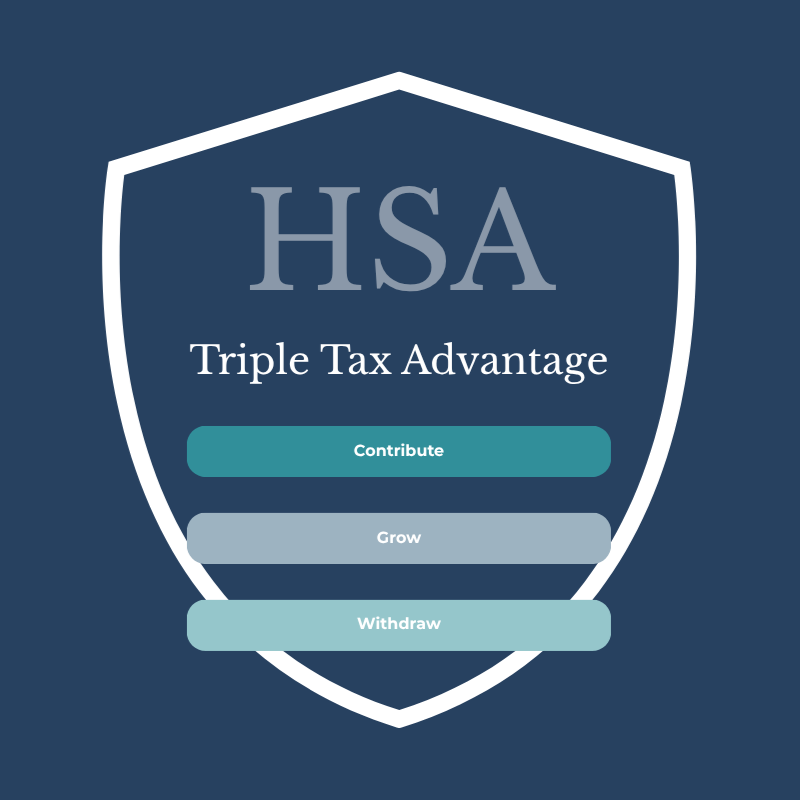
The Triple Tax Advantage
HSAs are unique in offering tax benefits at all three stages, contribution, growth, and withdrawal.
Contribute
Tax-deductible contributions reduce your taxable income now.
Grow
Investment earnings and interest accumulate tax-free.
Withdraw
Withdrawals for qualified medical expenses are completely tax-free.
Unlike an IRA (tax-deductible contributions but taxable withdrawals) or a Roth IRA (no deduction but tax-free withdrawals), the HSA gives you both. No other account does this.
Other HSA Plan Benefits
Unused balances can be spent in future years
There is no “use it or lose it” feature with HSAs like with a flexible spending account or FSA. Other health insurance related accounts can require that all balances be spent by the end of the year. If you don’t, that money disappears. This isn’t the case with HSA funds. Therefore, account balances are carried over for use in the future whether it be next year, in ten years, or beyond.
There is no income limitation
Some taxpayers are excluded from participating in certain tax advantaged accounts. For example, Roth IRAs offer the attractive option of funds that can used tax free in retirement. However, this is only an option for those with modified adjusted gross income (MAGI) under $153,000 for single filers and $242,00 for married filers (2026). Individuals and couples who couldn’t qualify for a Roth IRA based on income, might be eligible for the tax free benefits of an HSA.
Health Savings Account Taxation
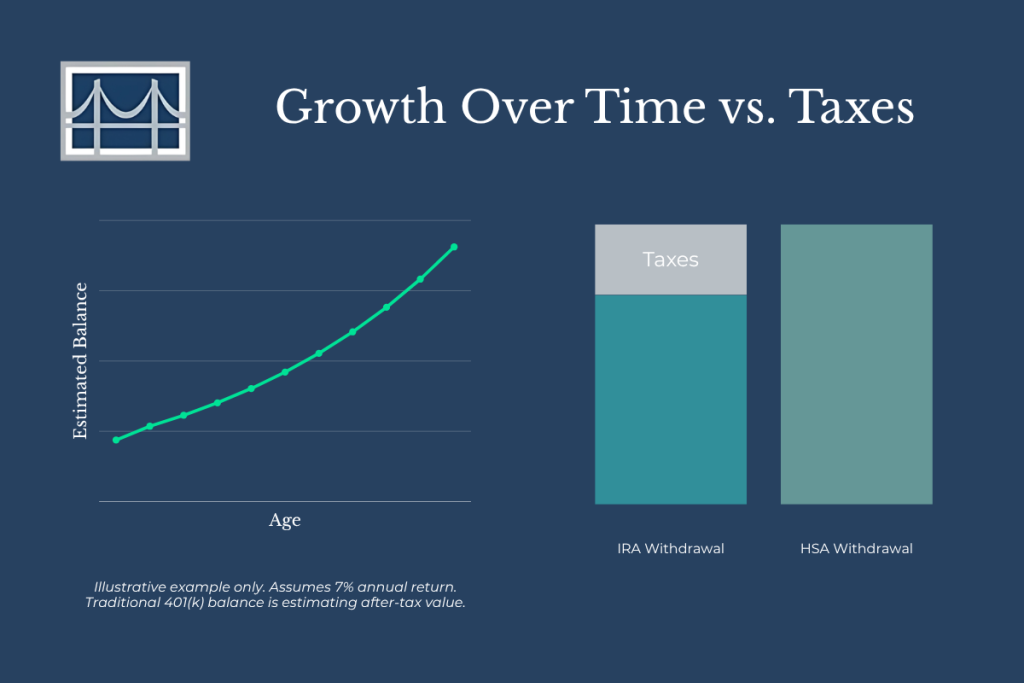
IRAs, Traditional 401(k), and 403(b) allow for tax deductible contributions which reduce current year income tax liability. While investment earnings aren’t taxed, the future withdrawals of principal and earnings are. This method of taxation often catches a lot of people by surprise upon retirement.
Think about replacing your annual income with withdrawals that are fully taxable as ordinary income. Most people are shocked by the amount of taxes owed each year. Consider a $10,000 distribution and while being in the 20% bracket. That means you end up netting $8,000. The other $2,000 goes straight to the Internal Revenue Service!
Roth IRAs and Roth 401(k) do not allow for a tax deduction. Contributions are known as “after tax” so they do not reduce income taxes. Investment earnings and future withdrawals are not taxed. This is why Roth IRAs are often referred to as “tax free” retirement accounts. I suggest taking a look at another article I wrote called Tax-Deferred vs Tax-Free Investment Accounts for more detail on this.
According to the Internal Revenue Service, HSAs allow for a tax deductible contribution that reduces current tax liability. In addition, the investment earnings and future withdrawals are tax free. This is like getting the best of both worlds. You get the tax deduction of an IRA and tax free withdrawals of a Roth IRA.
|
Traditional IRA / 401(k) |
Roth IRA / 401(k) |
HSA |
FSA |
|
|---|---|---|---|---|
|
Tax Deductible Contributions |
Yes |
No |
Yes |
Yes |
|
Tax Free Withdrawals |
No |
Yes |
Yes* |
Yes* |
|
Tax Free Growth |
Yes |
Yes |
Yes |
No |
|
Required Minimum Distributions |
Yes |
No |
No |
No, but you must use it or lose it. |
*For qualified medical expenses. After age 65, non-medical HSA withdrawals are taxed as ordinary income (like an IRA).
Health Savings Account Contribution Limits
$4,400
Individual
$8,750
Family
| Coverage Type | Base Limit | Age 55+ | vs. 2025 |
|---|---|---|---|
| Individual | $4,400 | $5,500 | +$100 |
| Family | $8,750 | $9,750 | +$200 |
No income limitation. Roth IRA eligibility phases out at $153,000 for single filers and $242,000 for married filers (2026). HSAs have no income restriction, making them a major tax-free savings tools available to high earners.
Contributions, for those with individual coverage, are limited to $4,400 ($5,400 for those 55 or older) in 2026. Those with family coverage can contribute up to $8,750 ($9,750 for those 55 or older). It is important to remember that these limits apply to employer and employee contributions combined. Therefore, you should be careful not to over fund the account. On the other hand, this is less of a concern if no employer contributions are involved.
Another consideration is that you can make contributions up until you file your taxes. This is similar to the way IRAs and Roth IRAs are funded. For example, as long as you are eligible to make a contribution to an HSA, you can fund the account by April 15 (or whichever day tax day falls on that year) for the prior tax year. While this created flexibility on one hand, it can create confusion on the other.
Make sure you know what year your contribution is funding. Many people have recurring monthly contributions so you need to be careful that you don’t inadvertently over fund the HSA. For example, consider that you have $200 per month on auto deposit in January through April. If those deposits are coded as “prior year contributions,” and you already maxed out your contribution limit by December, you run the risk of over funding.
HSA Plan Investments
Funds can be invested similar to a retirement account. A financial institution like a credit union or other investment providers offer HSA plans. Typically, the plans allow investments in mutual funds. Not all mutual funds are a like. You need to be sure to identify low cost funds that match with your investment objective. Working with a registered investment adviser can help.
Not all of the funds you contribute to the plan can be invested. Many HSA custodians will require a minimum balance of cash in the account to cover qualified medical expenses. You would want to sell a mutual fund in a down market to cover you medical expenses. After all, mutual funds are long term investments that need time to grow. Qualified medical expenses can come whether we are ready for them or not.
Let’s assume you design a well allocated moderate risk portfolio and leave an appropriate cash balance to cover immediate qualified medical expenses. The funds you don’t use are invested and have the potential to grow. Of course, this doesn’t come without risk and there’s no guarantee your funds will increase in value. However, if part of a disciplined investment strategy, there is potential to achieve returns in excess of bank savings or money market accounts.
Stealth Retirement Account
Before 65
Use for qualified medical expenses
Tax-free withdrawals for any eligible medical cost. Pay out-of-pocket when possible and let the account grow. You can reimburse yourself years later.
After 65
Use for qualified medical expenses
Non-medical withdrawals are taxed as ordinary income (same as an IRA). Medical withdrawals remain completely tax-free. And unlike IRAs, there are no Required Minimum Distributions.
No RMDs ever. Traditional IRAs and 401(k)s force distributions starting at age 73, which creates taxable income whether you need it or not. HSAs have no such requirement, giving you complete control over timing.
Savvy investors have figured out that HSA plans can be much more than health savings accounts. They can turbo charge your retirement and run circles around the flexible spending account. We’ve discussed the powerful tax advantages. As a review, contributions to a health savings account are tax deductible for the year they’re made. Additionally, the funds can be used tax-free for qualified medical expenses.
The added bonus happens at the magical age of 65. Once you turn 65, you withdraw funds from an HSA for any reason and only pay ordinary income tax. This would be the equivalent of taking a distribution from an IRA. But wait, there’s more. Unlike traditional IRAs, HSAs do not have required minimun distributions.
That means you can keep the funds invested without having to sell like you would with an IRA, 401(k), or other pre-tax retirement account.
The moral of the story is that the HSA gives you retirement options and powerful ones at that.
IRA Rollovers To HSA Plans
If you are eligible to participate in an HSA plan, you are allowed to rollover from an IRA. A common attribute of rollover transactions is the ability to do so tax and penalty free. One key distinction with rolling IRA funds to an HSA is that you can only do it once. In addition, you can only rollover up to the maximum contribution for that year.
Despite this, rolling funds from and IRA into an HSA might still be a wise financial move. As mentioned earlier, IRAs will ultimately be taxed when you withdraw in the future. HSAs, on the other hand, allow tax free withdrawals. Consider the following scenario.
A 45 year old (filing jointly) rolls over $7,100 from an IRA into a Health Savings Account. If those funds aren’t spent on out of pocket qualified medical expenses, over the next 20 years, it could reasonably grow to $18,838 (assuming 5% return). Now, at age 65, withdrawals can be made tax free. Stated another way, you could keep $3,767 in from falling into the hands of the Internal Revenue Service (assuming 20% tax rate).
HSA plans and California taxes
California Residents: California is one of only two states in the country that does not conform to federal HSA tax rules. The federal triple tax advantage does not fully apply on your California state return.
At the federal level, HSAs offer the full triple tax benefit. California has its own rules, and they are less favorable. The Franchise Tax Board (FTB) does not recognize HSAs as tax-advantaged accounts under state law.
|
Federal |
California |
|---|---|
|
Contributions are deductible |
Contributions are NOT deductible. |
|
Employer contributions excluded |
Employer contributions are NOT excluded |
|
Earnings are NOT taxed annually |
Earnings taxed annually |
|
Qualified withdrawals are NOT taxed |
Qualified withdrawals are taxed (state only) |
|
Early withdrawal penalty is 20% |
Early withdrawal penalty is 12.5% |
In practical terms, this means California residents must reverse federal HSA tax benefits on their state return each year. Contributions that reduced your federal taxable income must be added back on Schedule CA. Interest, dividends, and investment gains earned inside the HSA are taxable California income in the year they are earned, even though no 1099 is issued by the custodian.
Despite California’s treatment, the federal tax savings alone still make an HSA worth funding for most residents.
Health Savings Account (HSA) FAQ
At age 65, you can use HSA funds for any expense. Non-medical withdrawals are taxed like an IRA, but medical withdrawals remain tax-free. Unlike IRAs, HSAs have no required minimum distributions (RMDs).
To qualify for an HSA, you must: Be covered by a high deductible health plan (HDHP). Not have other non-HDHP health coverage. Not be enrolled in Medicare. Not be claimed as a dependent on someone else’s tax return.
Individuals: up to $4,400 ($5,400 if age 55+). Families: up to $8,750 ($9,750 if age 55+). These limits include both employer and employee contributions.
HSAs offer a “triple tax advantage”: Tax-deductible contributions (reduce taxable income). Tax-free growth on interest and investments. Tax-free withdrawals for qualified medical expenses.
Yes. Unlike a Flexible Spending Account (FSA), HSA balances roll over indefinitely. There is no “use it or lose it” rule.



After ignoring HSAs for a few years, I finally took the plunge last year after calculating that my insurance cost would effectively be the same as the normal PPO + FSA strategy that I was using before. Now, I’m not “looking” for medical expenses to pay at the end of the year so that I use up my FSA before the deadline… instead, I’m happy to let the balance roll over and accrue investment returns year after year!
Thanks Lee for your comment and sharing your experience. For a lot of people, it’s just one more thing to keep track of and get your arms around. Between company retirement accounts, personal investments, college savings plans etc., I can see how this can lead to “account fatigue.” I would be curious to know how many people with a high-deductible health plan (HDHP) DON’T utilize an HSA. I have a feeling that many people who could really benefit from an HSA are missing out.