
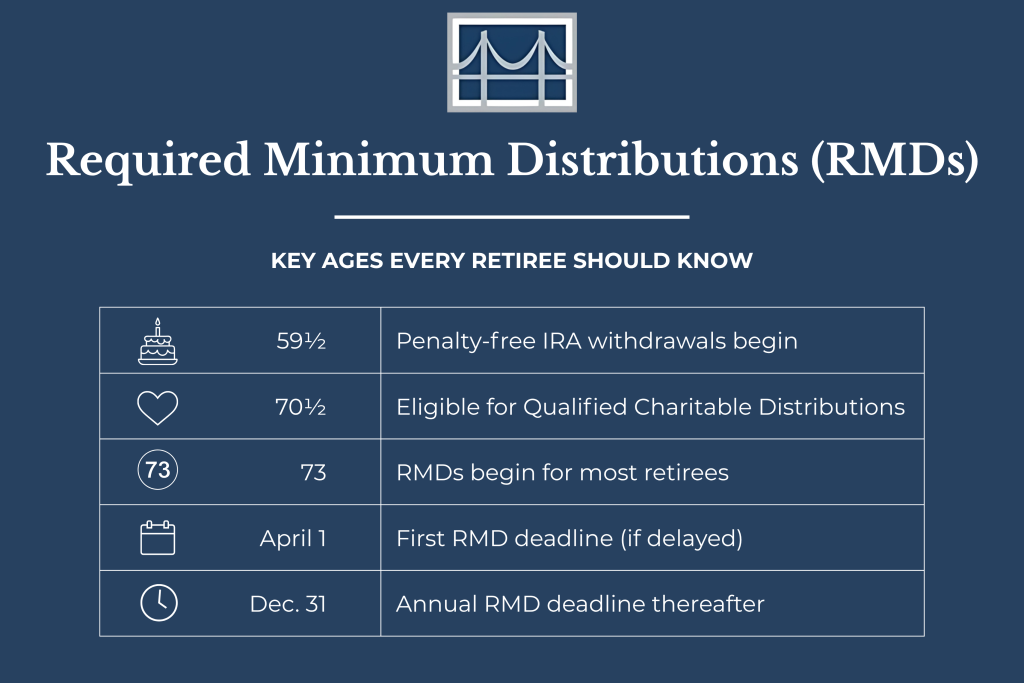
The IRS loves it when you turn 73, but you won’t get a gift or even a card. By doing so you’ve deferred taxes on investment earnings and reduced your taxable income over decades, but now the government says it’s time to pay up. Three little letters explain why: RMD.
Required Minimum Distributions are the minimum amounts the IRS requires you to withdraw each year from tax-deferred retirement accounts, traditional IRAs, 401(k)s, 403(b)s, and similar plans, so those long-deferred taxes can finally be collected
RMD Start Age
2026 Update
The Uniform Lifetime Table divisors are unchanged for 2026. For those turning 73 this year, the distribution period is 26.5 years. Roth 401(k) plans are now also RMD-free, beginning in 2025. The QCD limit has been updated to $111,000 for 2026.
What is a Required Minimum Distribution or RMD?
Required Minimum Distributions or RMDs are amounts that must be taken out of a retirement account each year so the IRS can tax the distribution.
You’ve worked hard and socked away funds tax deferred retirement accounts like IRAs and 401(k) plans. By doing so you’ve deferred taxes on the investment earnings and received a reduction in your taxable income by amounts you contributed each year.
You’ve watched the retirement funds grow over the long term but now that you’re 73, the IRS says it’s time to pay up and prepare to owe tax.
Key Takeaways
Estimate your 2026 Required Minimum Distribution
| Age | Distribution period | RMD on your balance |
|---|
This calculator uses the IRS Uniform Lifetime Table (Pub. 590-B, Table III). It applies to individuals born 1951–1959 with an RMD age of 73. If your spouse is the sole beneficiary and is more than 10 years younger, the Joint Life table may produce a lower RMD. This is an estimate only — consult a CERTIFIED FINANCIAL PLANNER® for your specific situation.
Uniform Lifetime Table
Your RMD grows each year as the distribution period shrinks. The table below shows the distribution factor and a sample RMD on a $1,000,000 balance.
| Age | Distribution period | RMD on $1M balance |
|---|---|---|
| 73 | 26.5 years | $37,736 |
| 74 | 25.5 years | $39,216 |
| 75 | 24.6 years | $40,650 |
| 76 | 23.7 years | $42,194 |
| 77 | 22.9 years | $43,668 |
| 78 | 22.0 years | $45,455 |
| 79 | 21.1 years | $47,393 |
| 80 | 20.2 years | $49,505 |
| 81 | 19.4 years | $51,546 |
| 82 | 18.5 years | $54,054 |
| 83 | 17.7 years | $56,497 |
| 84 | 16.8 years | $59,524 |
| 85 | 16.0 years | $62,500 |
| 86 | 15.2 years | $65,789 |
| 87 | 14.4 years | $69,444 |
| 88 | 13.7 years | $72,993 |
| 89 | 12.9 years | $77,519 |
| 90 | 12.2 years | $81,967 |
| 91 | 11.5 years | $86,957 |
| 92 | 10.8 years | $92,593 |
| 93 | 10.1 years | $99,010 |
| 94 | 9.5 years | $105,263 |
| 95 | 9.0 years | $111,111 |
Source: IRS Publication 590-B, Table III (Uniform Lifetime). For individuals born 1951–1959 (RMD age 73). Assumes a static $1M balance for illustration — actual balances change each year.
Deadlines and penalties
The IRS gives you until April 1 of the year following your first RMD year for that very first distribution, but every subsequent RMD must be taken by December 31.
Watch out for the double-distribution trap
If you defer your first RMD into the following year, you’ll take two distributions in the same calendar year. That can push you into a higher bracket and trigger higher Medicare premiums two years later (IRMAA)
Missing an RMD used to trigger a 50% excise tax. Thanks to SECURE 2.0, that’s now 25%, and down to 10% if you identify and correct the error within two years by taking the missed distribution and filing IRS Form 5329 with an explanation.
Tax strategies to reduce RMDs
Qualified Charitable Distributions (QCD)
Tax-free direct IRA transfer to charity. Counts toward RMD. 2026 limit: $111,000 per person (age 70½+).
Roth conversions
Move pre-tax IRA funds to a Roth. Taxable now, but shrinks the balance RMDs are calculated on. Best done before age 73.
Net Unrealized Appreciation (NUA)
For holders of highly appreciated company stock in a 401(k). Removes stock in-kind, rolling the rest to an IRA to reduce the pre-tax balance.
RMDs and Medicare premiums (IRMAA)
What you pay for Medicare Part B and D premiums depends on your income from two years prior. A jump in RMD income in 2026 could raise your premiums in 2028, a surprise that catches many retirees off guard. Work with your advisor to model IRMAA thresholds before your first RMD year.
Inherited IRAs
Spousal beneficiaries can treat the inherited IRA as their own and follow standard RMD rules. For everyone else, the rules are stricter: most non-spouse beneficiaries must fully distribute the account within 10 years. Under recent IRS guidance, annual RMDs may also be required during those 10 years if the original owner had already passed their required beginning date, substantially increasing the tax impact compared to the old “stretch IRA” strategy.
Frequently Asked Questions
An RMD is the minimum amount the IRS requires you to withdraw each year from traditional IRAs, 401(k)s, 403(b)s, and similar pre-tax retirement accounts. Because contributions and earnings were never taxed, the government eventually mandates withdrawals so it can collect. The amount is calculated by dividing your prior year-end account balance by a life-expectancy factor from the IRS Uniform Lifetime Table.
Under SECURE 2.0, the starting age depends on your birth year. If you were born between 1951 and 1959, your first RMD year is the year you turn 73. If you were born in 1960 or later, RMDs don’t begin until age 75, effective 2033. Your first RMD must be taken by April 1 of the following year; all subsequent RMDs are due by December 31 each year.
Divide your account balance as of December 31 of the prior year by the distribution period that corresponds to your age in the IRS Uniform Lifetime Table. For example, at age 73 the period is 26.5 years, so a $500,000 balance produces an RMD of about $18,868. Most IRA custodians will calculate this for you, but it remains your legal responsibility to withdraw the correct amount.
A missed RMD triggers a 25% excise tax on the amount that wasn’t withdrawn. If you catch the error promptly, take the missed distribution, and file IRS Form 5329 with a letter of explanation, the penalty may be reduced to 10%. Either way, the shortfall itself is still taxable income when you withdraw it.
No. Roth IRAs are not subject to RMDs during the account owner’s lifetime, because contributions are made with after-tax dollars. Growth and qualified distributions are tax-free. This makes Roth IRAs a powerful tool for minimizing lifetime taxes and for estate planning. Note that Roth 401(k) and Roth 403(b) plans are also now RMD-free beginning in 2025, thanks to SECURE 2.0.
Yes. A QCD is a direct transfer from your IRA to a qualified charity. It counts toward your RMD but is excluded from your taxable income — a meaningful advantage over taking the RMD and then donating separately. For 2026, individuals age 70½ or older can direct up to $111,000 per year to charity this way.
For traditional IRAs, yes, you must calculate the RMD separately for each IRA, but you can satisfy the combined total by withdrawing from one or a combination of accounts. The same rule applies to 403(b) plans. 401(k) plans are different: each must have its own RMD taken separately, which is another reason to consider consolidating old 401(k)s into an IRA when appropriate.
Yes. Converting traditional IRA funds to a Roth IRA reduces the pre-tax balance that RMDs are calculated on. While the conversion itself is a taxable event in the year it’s done, it permanently removes that money from the RMD equation. The best window is typically the years between retirement and age 73, when income may be lower.
Medicare Part B and D premiums are determined by your income from two years prior (the IRMAA lookback). A large RMD in 2026 could trigger higher Medicare premiums in 2028. This is one of the most commonly overlooked RMD side effects. Planning your withdrawal strategy, including Roth conversions and QCDs, can help manage your income relative to IRMAA thresholds.
Surviving spouses have the most flexibility and can treat an inherited IRA as their own. Most other (non-spouse) beneficiaries must distribute the entire account within 10 years of the original owner’s death. Under IRS guidance, if the original owner had already begun taking RMDs, beneficiaries may also be required to take annual distributions during that 10-year window, dramatically accelerating the tax bill compared to the old “stretch IRA” approach. Consult a CFP® before making any distribution decisions from an inherited account.
The rules around Required Minimum Distributions are complex and your situation is unique. Work with a CERTIFIED FINANCIAL PLANNER® to model RMDs, Roth conversions, QCDs, and IRMAA impacts as an integrated plan, not as separate decisions.





You are the only person I found currently giving correct RMD info – congratulations! Others still citing age of 70 1/2.
Thank you for the comment and I’m glad you found it helpful.